7 Ways to Reduce Gate Installation Costs - A Guide for Ontario Gate Installers

Updated: Aug 9
Gate installation costs can run high when you're sourcing components from multiple suppliers, fabricating custom parts on site, or working through an unfamiliar product line.
For gate installers across Ontario — working residential projects in the GTA, commercial sites in the industrial belt, or municipal contracts in Northern Ontario — there are practical ways to bring costs down without cutting corners on quality or compliance.
This article covers the most effective strategies, from specifying the right products upfront to reducing wiring time and minimizing callbacks in Ontario's demanding four-season climate.
Here's what we'll cover:
What You Can Do To Reduce Gate Installation Costs as a Contractor
The table below summarizes the main cost-reduction strategies covered in this guide, with approximate savings potential for each.
Savings figures are estimates based on typical Ontario gate installation projects and will vary depending on project size, site conditions, and scope. Use these as a planning guide, not a guarantee.
Cost Saver | Where It Applies | Estimated Savings | Notes |
1. Use a plug-and-play gate kit instead of a fully custom gate | Residential, commercial | 30 – 40% of total project cost | Eliminates on-site fabrication, painting, and field wiring; a project that might run $50,000 custom can come in at $30,000 with the right kit |
2. Specify rack drive over chain drive on commercial slide gates | Commercial, industrial | $500 – $2,000/year in avoided maintenance | Higher upfront cost but eliminates lubrication, reduces service calls, and avoids cold-weather chain failures common on Ontario sites |
3. Specify a pre-wired control system | Commercial, industrial | 10 – 20% of installation labour | Reduces licensed electrician time on site; eliminates field wiring errors that delay commissioning or fail ESA inspection |
4. Use quality direct burial ground loops instead of standard wire | All gate types | $800 – $2,500 per callback avoided | Higher upfront cost offset by avoiding return visits, concrete cutting, and loop replacement caused by Ontario freeze-thaw damage |
5. Use wedge-anchor cantilever hardware instead of wet-set rod systems | Cantilever slide gates | 15 – 25% of cantilever installation labour | Eliminates wet-set process; allows post-pour adjustment; reduces on-site welding and alignment time |
6. Specify compliant gate equipment from the start | Commercial, municipal | Avoids project delays and post-installation modifications costing $5,000 – $20,000+ | UL325 and ASTM F2200 compliance required on government and municipal projects; non-compliance discovered after installation is expensive to correct |
7. Work with a gate-specialized supplier | All gate types | Varies; reduces sourcing time, ordering errors, and unfamiliar-product delays | Direct technical support reduces time spent troubleshooting; fast turnaround reduces project idle time |
1. Use Plug-and-Play Gate Kits
The most direct way to reduce gate installation costs is to reduce on-site fabrication time, and plug-and-play gate kits are built specifically for that. Instead of sourcing a gate frame, operator, hardware, and wiring separately — then spending hours assembling and adjusting on site — a complete kit arrives factory-built, pre-painted, and pre-wired, ready to bolt down once the concrete cures.
For residential projects in Ontario, this approach can bring a project that might otherwise run $50,000 for a fully custom automated gate down to the $30,000 range — a saving of roughly 30 to 40% — while delivering equal or better quality.
The gate itself is factory-finished to a standard difficult to match in the field, and the pre-mounted automation means the installation is faster and less dependent on trade coordination on site. There is no welding, no field painting, and no figuring out operator geometry after the fact.
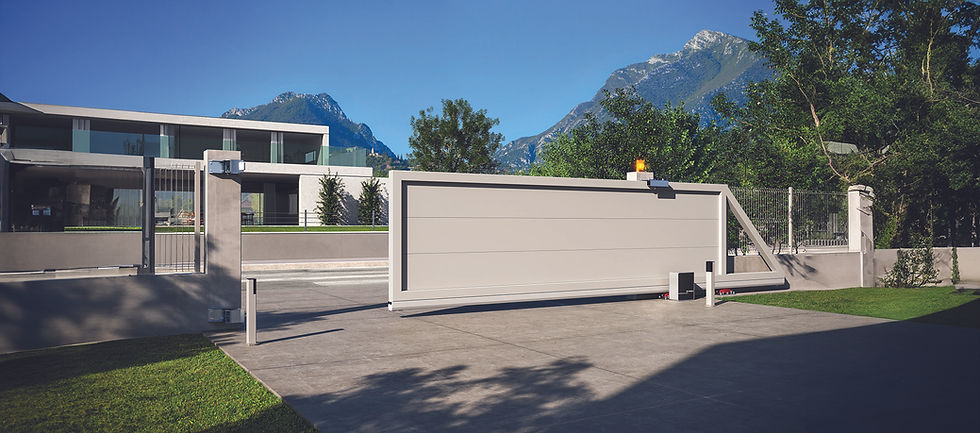
For commercial projects across Ontario, the same principle applies at a larger scale. A complete cantilever slide gate kit includes the gate frame, cantilever hardware, drive operator, pre-wired control system, and all safety components.
Once the concrete pad is in and power is connected, the installation is complete. That eliminates a substantial amount of on-site labour compared to assembling a commercial slide gate from individually sourced components — and it reduces the coordination overhead between trades on the job site.
2. Choose Rack Drive Over Chain Drive
Chain drive operators are the default on most commercial slide gates — roughly 90% of the Ontario market — but they carry ongoing maintenance costs that a rack drive system eliminates entirely. Chain drives require regular lubrication, attract dirt and debris, and are prone to coming off their limits in cold weather.
In Ontario winters, where temperatures can drop well below -20°C, a chain that has stiffened from cold or accumulated grime from road-salt spray is a service call waiting to happen.
A typical maintenance visit runs $300 to $600 in Ontario, and a chain replacement on a commercial slide gate can run $500 to $1,500 including parts and labour — costs that repeat over the life of the installation.
A solid steel rack drive, by contrast, requires no grease and no maintenance. It does not freeze or stiffen in winter, it is far harder to snap or knock off, and it's more difficult to defeat from a security standpoint.
The upfront cost is higher than a chain drive by roughly $1,000 to $2,000 on a standard commercial gate, but the absence of maintenance and the reduction in service callbacks makes it the lower-cost option over the life of the installation on any Ontario commercial site.
When you're quoting a commercial gate project, the rack drive maintenance argument is also one of the clearest ways to justify a higher-quality system to a client — lower lifetime cost is a straightforward conversation to have with a property manager or facilities team.
3. Specify Pre-Wired Control Systems
Wiring a gate control system from scratch takes time, requires an ESA-compliant electrician — a mandatory requirement for any automated gate installation in Ontario — and introduces the possibility of errors on commissioning. Those errors cost money: a failed ESA inspection, a commissioning delay, or a wiring fault that damages a control board all generate unplanned expense. Pre-wired control systems eliminate most of that risk.
A pre-wired control system arrives with the control board, loop detector inputs, push-in connectors, disconnect switch, surge protection, and grounding already installed and tested. Once power reaches the box, no external wiring is required.
On a standard commercial gate installation, that reduces licensed electrician time on site by 30 to 50% compared to field-wiring a control system from a bare enclosure.
Pre-wired portal equipment — safety edges, photocells, and lights — adds to that saving by eliminating the need to run conduit to individual safety devices. For Ontario installers doing multiple gate projects per season, the cumulative saving across a full project calendar is substantial.
4. Install Quality Ground Loops the First Time
Ground loop callbacks are one of the most common and most avoidable sources of extra cost on Ontario gate installations. Ontario's freeze-thaw cycle is relentless — water infiltrates a poorly sealed loop cut, freezes, and physically damages the wire. A loop replacement means returning to site, cutting the concrete or asphalt, pulling the failed loop, installing a new one, sealing the cut, and commissioning again.
That return visit typically costs $800 to $2,500 depending on access and pavement type — far more than the cost difference between a quality loop and a standard one at the time of installation.
Higher-quality direct burial loops are built with liquid-tight conduit rather than standard burial wire, making them significantly more resistant to physical damage and corrosion. They are designed specifically for ground conditions that include freeze-thaw cycles — not just warm-climate installations.
For saw-cut installations, using a quality loop sealant over the cut adds a small cost but eliminates the primary failure mode caused by water infiltration and freezing.
Installation specs matter as well:
Direct burial in gravel: bury at 6 to 10 inches depth
Saw cut into asphalt or concrete: cut to 1.5 inches depth with a 3/16-inch blade
Lead length: standard is 50 feet back to the detector or control box; longer leads available on special order
Pairing the loop with an adjustable-sensitivity loop detector adds another layer of protection against callbacks. If a vehicle isn't triggering the loop due to pavement depth or concrete layers — a common issue on Ontario commercial sites with thick asphalt pads — you can increase sensitivity in the field rather than pulling the loop and reinstalling at a different depth.
5. Simplify Cantilever Hardware Installation
Cantilever hardware installation has traditionally been one of the more labour-intensive parts of a slide gate project in Ontario. The industry standard involves setting six wet-set threaded rods in concrete for each roller — a process that is time-consuming, requires precise alignment during the pour, and is difficult to adjust after the fact if something is off. A misaligned wet-set rod means grinding, re-pouring, or working around a geometry problem that compounds through the rest of the installation.
Wedge-anchor cantilever systems bypass all of that. The rollers anchor into cured concrete with two wedge anchors rather than six wet-set rods. You pour your pad, let it cure, drill your anchor holes, and bolt the rollers down.
Large adjustment slots in the roller assembly allow fine alignment after the fact — far more practical than trying to get six wet-set rods perfectly positioned in a single pour. That process change alone reduces cantilever hardware installation labour by 15 to 25% on a typical Ontario commercial gate project.
Cantilever track systems that allow the drive rack to be drilled and tapped rather than welded in further reduce on-site time and eliminate the need for welding equipment on site, the risk of heat distortion in the track, and the discomfort of welding at ground level in Ontario weather conditions. Track systems with integrated drive rack channels take this further — no separate rack attachment step at all.
6. Get Compliance Right Early
On commercial and municipal gate projects in Ontario, compliance with UL325 and ASTM F2200 is not optional — and discovering a compliance problem after installation is one of the most expensive outcomes possible.
A non-compliant gate on a government or municipal project can mean a required tear-out and replacement, rejection of the submission package, or significant project delays while a compliant solution is sourced and installed.
The cost of that outcome — in materials, labour, and project delay — commonly runs $5,000 to $20,000 or more depending on project scale.
Specifying compliant gate equipment from the start eliminates that risk entirely. For Ontario installers tendering commercial and municipal projects, using gate systems that are UL325 and ASTM F2200 compliant and can be documented with spec manuals, typical drawings, and site layout plans is the baseline requirement.
Sorting out compliance documentation during the quoting phase — rather than after the gate is installed — keeps the project moving and eliminates post-installation surprises.
7. Work with a Knowledgeable Supplier
A significant portion of the hidden cost on Ontario gate installations comes from time spent sourcing components across multiple suppliers, waiting on back-orders, or working through an unfamiliar product for the first time. Time on the phone, delays waiting for parts, and first-install learning curves all add cost to a project without adding value. A supplier who knows gate hardware — not just catalogs it — can shorten all of those timelines.
For Ontario installers, having a local supplier who understands the province's climate, compliance requirements, and the specific demands of four-season gate operation makes a real difference.
Direct technical support reduces time spent troubleshooting unfamiliar equipment. Fast turnaround on orders reduces project idle time. And a supplier who can provide drawings and site layout plans for cantilever and commercial gate projects reduces the documentation burden on you. All of those translate into lower project costs over a full season of work.
Familiarity with a product line also reduces installation time with every project you do on that line. The first installation on a new product takes longer. The fifth installation takes a fraction of the time. Working consistently with one well-supported product line builds that efficiency, and it's one of the reasons Ontario installers who work with us tend to move toward standard configurations that reduce their per-project cost over time.
Get Hardware for Your Gate Project from Graft Gate Supply
Graft Gate Supply is a gate hardware supplier based in Brampton, serving installers across Ontario.
We carry the hardware, automation, and access control equipment to support residential, commercial, and municipal gate projects throughout the province — including complete plug-and-play gate kits, cantilever hardware, swing gate operators, vehicle detection loop systems, and access control components.